Start with the concern people actually notice
Metals often dominate the public water conversation, but microbiological testing still belongs in any serious review. In New Jersey private wells, older buildings, low-use properties, rental buildings, and commercial spaces, the question usually begins with a visible change, a taste complaint, a child’s routine, a renovation, or a worry about contaminants that may not be obvious from appearance alone. The strongest response is to move from assumption to a structured testing plan. Professional water testing services help connect the concern to the actual property, sample location, and daily use pattern. That matters because the same symptom can mean different things in different buildings. Testing gives families and property teams a more useful starting point than guessing from a glass of water.
Why the property context matters
Water does not reach the tap in isolation. It passes through fixtures, branch lines, valves, building plumbing, private well components in some cases, and sometimes shared distribution systems. In New Jersey, the property may include recent upgrades beside older materials, rarely used outlets beside high-use sinks, or private units connected to common infrastructure. That is why making microbiological testing part of a serious water quality program requires more than a generic checklist. A result becomes more useful when the sample location reflects the real concern, whether that concern involves total coliform, E. coli, HPC, stagnation, water use patterns, and potability indicators. The property context helps decide what should be tested and how the results should be read.
What official guidance can and cannot do
Bacteria testing is easier to understand when official resources are used alongside property details. The NJDEP private well testing page explains why testing matters for well owners, while the CDC private well resource gives useful public health context. The EPA drinking water page frames drinking water quality more broadly. A property sample is still needed to understand local conditions.
Why certified analysis is stronger than appearance
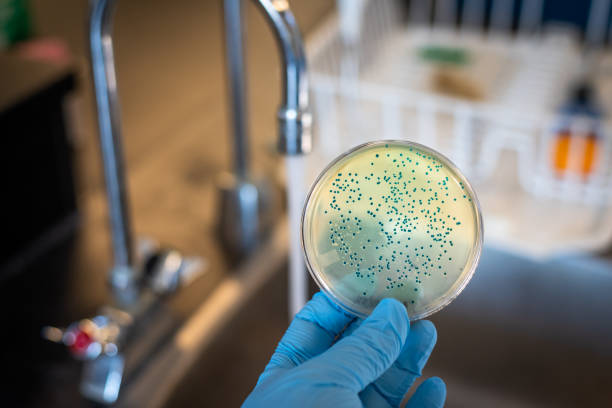
Bacteria indicators cannot be ruled out by looking at water. Clear water may still require testing, and cloudy water does not identify the organism or indicator involved. The laboratory analysis process is important because microbiological testing depends on proper sample handling, defined methods, and clear reporting. It answers a different question than metals testing.
Choosing the right test scope
A serious water program should not stop at metals when bacteria indicators are relevant. Coliform, E. coli, HPC, or related potability indicators may matter depending on the property. Reviewing what we test helps property teams understand where bacteria testing fits beside lead, copper, PFAS, and other water quality questions.
Sample location can change the meaning
One of the most important parts of any water testing plan is choosing where the sample should come from. The nearest faucet is not always the most representative outlet. A fixture used for drinking may be more meaningful than a rarely used sink. A shared-building concern may require more than one unit or more than one point of use. A commercial property may need to consider staff areas, public-use fixtures, and tenant spaces differently. For homeowners, property managers, and building teams, the sample location should answer the practical question behind the test: whether the water program is broad enough to address biological indicators, not just metals or visible complaints.
How results should be used
Bacteria results may lead to resampling, maintenance review, well evaluation, disinfection steps, or closer review of low-use fixtures. A clear result can also help a property team confirm that the sampled point did not show the indicator tested. The CDC private well resource helps explain why routine attention can matter for properties outside typical public-water oversight.
Questions to ask before collecting samples
Before bacteria testing, property teams should ask whether the building has low-use areas, recent vacancy, private well components, plumbing repairs, or recurring odor and cloudiness complaints. They should also follow sample collection instructions carefully because poor handling can affect the usefulness of the result.
A New Jersey-focused way forward
For New Jersey homeowners, property managers, and building teams, the best approach is focused and practical: define the concern, choose meaningful sample points, select a relevant panel, and interpret the result in context. That process makes water testing useful whether the concern is lead, bacteria, PFAS, corrosion, appearance, taste, or shared plumbing. Families and property teams can explore service areas through the locations page and ask questions through the contact page. Stronger answers begin when the water question is tied to the real property and the people who use it every day.
Why this extra context matters
Bacteria testing is especially important because microbiological concerns are not always visible. Water can look normal while still requiring attention, and a metals-only panel will not answer bacteria questions. Properties with low-use fixtures, seasonal occupancy, private wells, or unusual flow patterns may benefit from a program that includes biological indicators. A serious water program should be broad enough to ask what metals and microbiology may each reveal.
A bacteria result can also shape immediate practical steps. If indicators are absent, the property gains reassurance for that sample. If indicators are present, the response may involve resampling, maintenance, disinfection review, well evaluation, or a closer look at low-use fixtures and system conditions.
Why bacteria questions are different from metals
Bacteria indicators tell a different story from metals. Lead, copper, and iron often connect to plumbing materials and corrosion behavior. Coliform or E. coli concerns may point toward source protection, treatment, sanitary conditions, stagnation, or system integrity. That difference matters because a clean metals panel does not answer microbiological questions. A serious program should recognize that water can require multiple lenses depending on the property.
When bacteria testing becomes especially important
Bacteria testing deserves attention in private well properties, low-use buildings, vacant units, seasonal spaces, and properties with unusual water use patterns. It can also matter when odor, cloudiness, or recurring complaints appear. In some situations, testing may be part of routine monitoring rather than a reaction to a visible problem. Including bacteria in the program helps avoid a narrow focus that misses an important part of water quality.
A bacteria result can also shape immediate practical steps. If indicators are absent, the property gains reassurance for that sample. If indicators are present, the response may involve resampling, maintenance, disinfection review, well evaluation, or a closer look at low-use fixtures and system conditions.
Bacteria testing also supports better timing decisions. Some properties should test routinely, while others may test after vacancy, repairs, flooding concerns, well work, or unusual odor and cloudiness. The important point is that bacteria questions should not be ignored simply because metals get more attention. A complete program asks what the property conditions suggest and then chooses a testing schedule that fits those conditions.
When bacteria testing is included, the property team also gains a better baseline for future decisions. If use patterns change, repairs occur, or complaints return, the earlier result can help show whether conditions changed over time.